













The Olympic Games are back, and this time around they’re being hosted in Milan and Cortina d’Ampezzo, Italy. In preparation for the thousands of athletes and millions of visitors, Milan has expanded its metro service’s hours and extended two main underground lines, the M1 and M2. This has become a recurring theme in recent years. In 2024, the Summer Olympics in Paris were fully public transit-based, with venues close to easily accessible Metro and regional rail stations. The next Olympic Games are set to be in Los Angeles.
In 2028, Los Angeles will become the third city ever, following London and Paris, to have hosted the Games three times. Los Angeles has hosted the Olympics twice before: in 1932, and in 1984, both very successful. The 1932 Games hosted more visitors than ever before, with 100,000 guests attending the opening ceremony. Los Angeles also astonished the world with the unprecedented scale and quality of the Coliseum Olympic stadium, today known as the Los Angeles Memorial Coliseum. Los Angeles 1984 made history for female athletes, with two new disciplines – synchronized swimming and rhythmic gymnastics – being added exclusively for women. 23 percent of athletes in 1984 were women, a record at the time.
However, Los Angeles today is very different from Los Angeles in the 1980s. The city’s population has grown by more than 1.5 million since 1980, and does not have as developed of a public transit system as Milan. Athletes, attendees and equipment need to be transported between more than 80 venues, including the Crypto.com Arena and SoFi Stadium, in a city that’s already known for its car culture and heavy traffic.
Los Angeles Mayor Karen Bass has announced that she and the LA28 team are working towards a “public transport-first,” “car-less” Olympics to manage traffic flow, in an interview with KABC-TV. Additionally, businesses have been encouraged to allow employees to work from home during the 17-day period to lessen the amount of cars on the road.
Additionally, in preparation for the Olympic demand, LA Metro has received a grant from the Los Angeles Department of Transportation to develop the Games Enhanced Transportation System (GETS) to deliver a “transit-first,” zero-emission and car-free transportation network for LA28. This will involve buses and shuttles borrowed from other transit agencies, bus malls at venues and a link between rail/busway stations and venues. Supervisor Janice Hahn of Los Angeles’s fourth district and a member of the Metro Board of Directors said that the emphasis on public transit will continue post-Olympics as well.
“LA is going to welcome the world for the 2028 Olympics, and that offers us a great opportunity to not only think bigger about how we can move those visitors around LA County, but how we can make long-term transit investments for everyone who calls LA County home, even after the Games,” said Hahn.
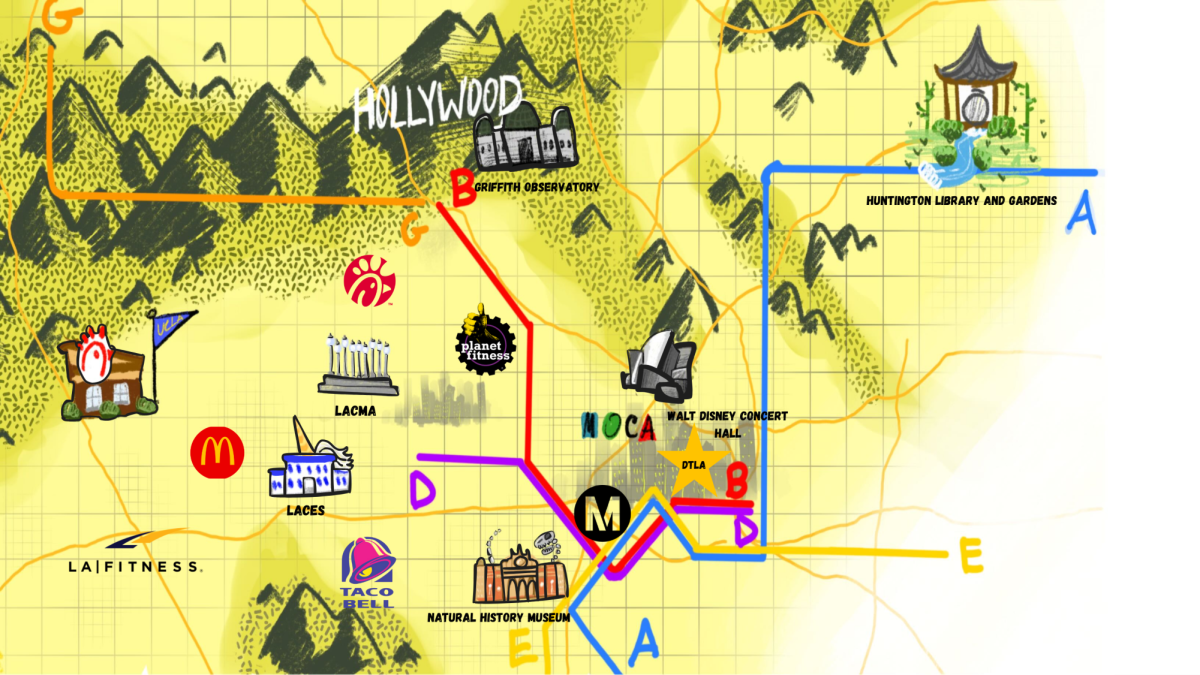
Of the many long-term projects planned by the city, LACES students will be able to reap the benefits of a few in particular. The upcoming D Line Subway Extension Project will add nine miles of subway service to Metro’s network with seven new stations between Koreatown and Westwood. After its anticipated completion in 2027, Angelenos will be able to travel from Downtown to Westwood in just 25 minutes as opposed to an hour now. The line extension also connects popular cultural institutions and neighborhoods like LACMA, Beverly Hills and Westwood Village. Additionally, the LAX/Metro Transit Center was just completed in 2025, connecting Metro’s C and K lines to LAX with a free airport shuttle.
Public transport isn’t just needed for the Olympics. It’s necessary for the city. Rachel Burke, Chief Program Officer at CicLAvia, a non-profit that temporarily closes streets to cars and opens them to biking, walking and skating, says that these public transit projects will benefit Los Angeles’s future.
“Better transit means people can get to school, work and community spaces more easily and affordably, regardless of whether they own a car. It also reduces traffic, improves air quality and helps address climate change. Over time, these shifts can make neighborhoods safer, healthier and more connected,” said Burke.
She emphasizes that when the streets are filled with people rather than cars, like when CicLAvia is putting on an event, the city is better able to connect and strengthen community ties.
“When streets are designed for people – not just vehicles – cities become places where community life can thrive. That’s the future CicLAvia has been working toward, and the Olympics present a powerful opportunity to move Los Angeles closer to it… For more than a decade, CicLAvia has shown what it looks like when streets are designed for people rather than cars – when walking, biking, rolling, and transit are easy, safe, and joyful,” she said.
She also notes that although CicLAvia is not directly involved in planning for the 2028 Games, the two organizations have the same goal: a better future for the city.
“Plans for Olympics-related transportation and community activities are still being developed, and CicLAvia is actively part of those conversations. As the city prepares to welcome the world in 2028, we hope CicLAvia’s model can help inspire how Los Angeles invests in transportation and public space in ways that benefit residents long after the Olympics are over,” said Burke.
The 2028 Olympic Games provide Los Angeles with an opportunity to take the first step towards serious progress in public transportation, an opportunity that can – and will – transform the city and serve local communities for years after the Olympic torch’s flame is extinguished, according to Hahn.
“I believe that if we get creative, we can deliver a great transit-first Olympics experience and also create a better-connected county for our young people and for future generations,” said Hahn.